


Here's the optimized and rewritten article, transformed into a publication-ready blog post:
Are you struggling to wrangle your WordPress website's layout? Do terms like "widgets" and "blocks" sometimes feel interchangeable, yet you know they're fundamentally different? You're not alone. The evolution of WordPress from traditional widgets to the versatile block system has left many users wondering: When do I use what? And what's the best approach for a modern WordPress site?
At ShareWordpress, we've spent years observing and testing WordPress's every twist and turn. We understand that navigating these changes can be a head-scratcher. But mastering the distinction between widgets and blocks isn't just about technical knowledge; it's about unlocking a new level of control, flexibility, and future-proofing for your website.
This comprehensive guide will demystify WordPress widgets and blocks once and for all. We'll delve into their origins, practical applications, and how they seamlessly (or sometimes confusingly) integrate in today's WordPress landscape. Drawing from our experience helping thousands of users build and customize their sites, we'll equip you with the knowledge to make informed decisions that elevate your WordPress presence.
Here's a quick overview of the essential topics we will cover in this article, guiding you to a clearer understanding:
Let’s dive right in and unlock your WordPress potential!
Imagine a time before easy website customization. That's the era WordPress widgets emerged from. Introduced in WordPress 2.2 (May 2007), widgets were revolutionary. They provided a user-friendly way to add dynamic content modules to "widget-ready" areas of your theme, typically sidebars and footers.
Before widgets, customizing these accessory areas often involved directly editing theme files – a daunting task for non-developers. Now, you could simply drag and drop elements like a recent posts list, an email sign-up form, or even Google AdSense tracking codes without touching a single line of code.
Widgets empowered non-technical users to build their ideal WordPress blog, making site design accessible and efficient. This ease of use led almost all major WordPress themes to integrate widget-ready areas into their designs.
Until WordPress 5.8 in 2021, the WordPress widget editor presented a clear, intuitive interface:

This laid the groundwork for a more modular approach to content management.
Fast forward to WordPress 5.0, which ushered in a new era with the block-based content editor, famously code-named 'Gutenberg.'
Conceptually, blocks are quite similar to widgets: each represents a self-contained element of content or functionality. However, blocks dramatically expand the possibilities. Initially, blocks were designed specifically for the post and page editor, allowing users granular control over every piece of content – from a simple paragraph to an image gallery, a video embed, or even plugin-specific features like custom forms.
Blocks transform your content creation experience. They allow you to add and arrange various elements precisely where you want them, giving you immense design flexibility.

Beyond basic content, the block editor offers specialized blocks for layout and design, including covers, patterns, tables, columns, and groups. This empowers you to build sophisticated layouts directly within your posts and pages. For a deeper dive, explore our complete WordPress block editor tutorial.
For years, the distinction between widgets and blocks was crystal clear. Widgets lived in static, designated "widget areas" like sidebars and footers, serving as site-wide modules. Blocks, on the other hand, were confined to the main content area of posts and pages, allowing for rich, dynamic layouts within your primary content.
Widgets were the workhorses for displaying ancillary elements – recent posts, vital links, banner ads, and various forms – content outside the main article flow.
However, with the release of WordPress 5.8, this once-obvious separation has significantly blurred.
Today, here’s the crucial difference:
While widgets initially pioneered the way for developers to output elements like contact forms, testimonials, or social media feeds, blocks now offer the same, if not greater, capabilities. Many top WordPress plugins have embraced the block paradigm, providing dedicated blocks you can insert anywhere.

Consider these powerful examples:
This cross-compatibility underscores the block editor’s increasing dominance.
The strategic goal of WordPress development is a unified editing experience across your entire website. This vision materialized significantly with the introduction of the new block-based widget editor in WordPress 5.8.
This update means you can now employ the power and flexibility of blocks directly within your theme's widget-ready areas.

You'll still find your widget settings under Appearance » Widgets. However, if you're utilizing a block-based theme that doesn't define traditional widget areas, this menu item might be absent. Instead, you’ll likely see Appearance » Editor, giving you direct access to theme-wide content editing through blocks.

Many legacy WordPress widgets now have equivalent, more powerful blocks. When you click the ‘add new block’ button (+), you’ll find a dedicated "Widgets" category, making the transition seamless for users familiar with the old system.
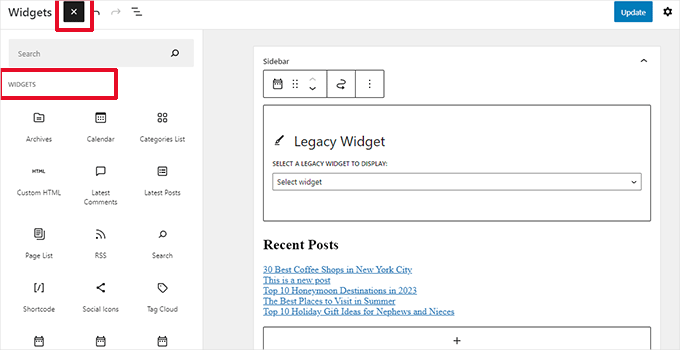
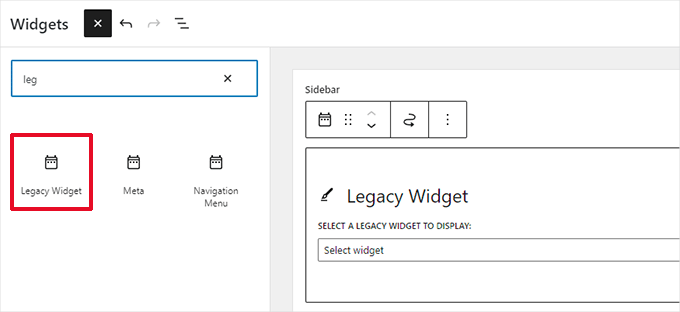
These are, in essence, blocks, but they are thoughtfully categorized as 'Widgets' to help users understand their role in familiar widget locations. For those rare instances where a specific legacy widget lacks a direct block equivalent, WordPress provides a "Legacy Widgets" block, allowing you to embed older widgets without disruptions.
This evolution means that if a WordPress plugin offers a block for posts and pages, you can now seamlessly use that same block in your widget areas, dramatically increasing design consistency and flexibility across your site. Theme developers are also empowered to create custom blocks, further expanding your customization options.
WordPress is unequivocally moving towards a more intuitive, unified, and block-driven editing experience. This direction means that traditional, older widgets will eventually be phased out as the ecosystem fully embraces blocks. WordPress themes and plugin developers are already adapting, prioritizing and adding robust support for the block editor in their products.
However, the transition isn't instantaneous. Many "classic themes" and numerous WordPress plugins still rely on older widget structures and shortcodes.
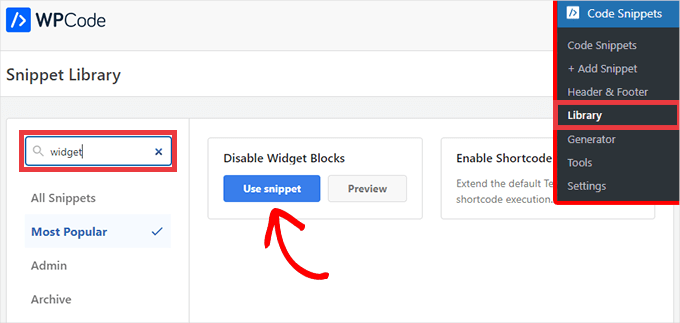
If your current setup requires the continued use of old widgets, you have options. Most importantly, you can disable block widgets in WordPress to revert to the classic widget interface.
Our recommended method for this, and for any WordPress customization, is the free WPCode plugin. This powerful plugin allows you to safely add custom code snippets – like the one to disable block widgets – without cluttering your installation with dozens of individual plugins. We trust WPCode for its robust functionality and ease of use, even offering a pre-made snippet for this exact purpose:
Alternatively, the Classic Widgets plugin can achieve the same result. You can follow our step-by-step guide on how to install a WordPress plugin if you choose this route.
Important Note: While the Classic Widgets plugin currently receives updates and support, this is slated to continue "until 2024 or as long as the WordPress team deems it necessary." This suggests a finite lifespan. For long-term peace of mind and future-proofing your WordPress site, we strongly recommend using WPCode for such customizations.
The answer is clear: Blocks are the future of WordPress customization, offering superior flexibility, control, and a unified editing experience.
We strongly advocate for users to begin adopting the new block-based widget editor as soon as possible. This aligns your site with the future direction of WordPress development, ensuring your site remains modern, maintainable, and highly flexible. The block editor is not just easy to use; it’s a robust, intuitive system that transforms how you manage your content and layouts.
If you find that a WordPress plugin or theme you use still relies heavily on older widgets and lacks adequate block support, we encourage you to reach out to the developer. Request that they convert their widgets into blocks to embrace the modern WordPress paradigm. Should they not have plans for such updates, it might be time to explore alternative plugins or themes that fully support the block editor, empowering you with the best tools for your site.
Here are some common questions we receive from our readers regarding WordPress blocks and widgets:
What happens to my old widgets if I switch themes or update WordPress?
When you switch themes, your existing widgets will generally migrate to your new theme’s widget areas, provided those areas exist. If your new theme supports the block-based widget editor, WordPress will do its best to preserve the content and structure, automatically converting your old widgets into their block equivalents where possible.
Can I still use widgets in newer versions of WordPress?
Yes, you can. However, they now primarily appear within the block-based Widgets screen (introduced in WordPress 5.8 and later). While they function within this block environment, you do have the option to install a plugin like Classic Widgets or use WPCode’s snippet to restore the traditional widget interface if needed.
Do I need to switch all my widgets to blocks?
Not immediately, but it is highly recommended. Transitioning to blocks offers significantly more control, flexibility, and design capabilities. The block editor allows you to style your content with greater precision, preview changes easily, and many modern themes and plugins are optimized for block-based layouts, delivering a smoother and more powerful experience.
We sincerely hope this article has provided you with a crystal-clear understanding of the essential differences between WordPress widgets and blocks, empowering you to navigate the evolving WordPress landscape with confidence.
To continue building your WordPress expertise, we also recommend exploring our pick of the best block plugins for WordPress and our comprehensive guide on the difference between the block editor vs. page builders.
If you found this article helpful and insightful, please consider subscribing to our YouTube Channel for detailed WordPress video tutorials. You can also join our vibrant community and connect with us on Twitter and Facebook. Your engagement helps us continue to produce valuable resources for the WordPress community!
